Seventh Stop
Workshop at the Gothenburg City Library · March 2026
Workshop Leaders: Leila Natsheh and Simona Cavalieri
Workshop Assistant: Priyadarshini Chilaka
Workshop Assistant: Priyadarshini Chilaka
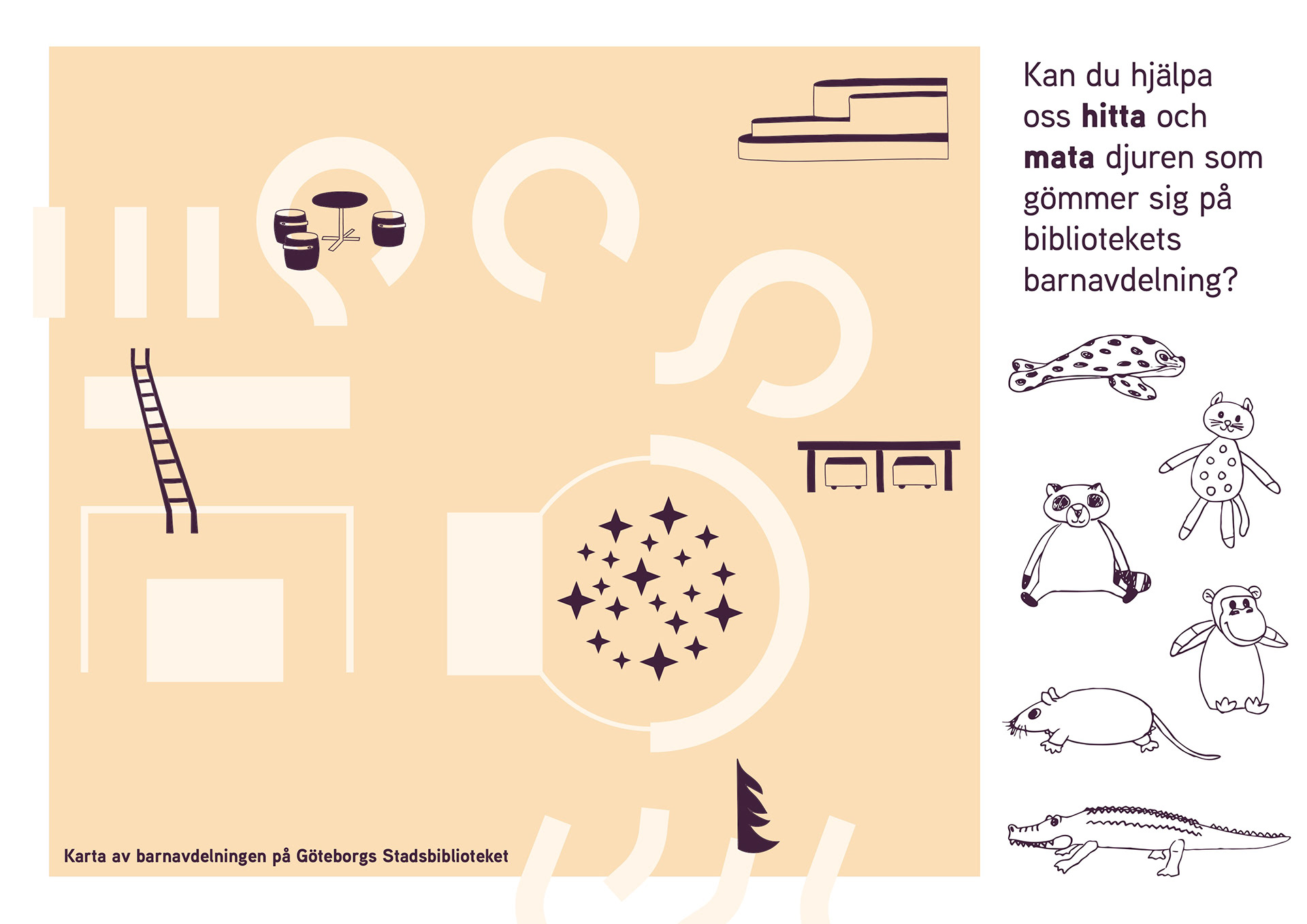
Map Design: Leila Natsheh
This workshop at the Gothenburg City Library was designed for children aged 3-5. Rather than following our other workshops' storyline of the spaceship and traveling in outer space, we designed this workshop with as much familiarity as possible for this age group. We hid plushies in the library, and gave each participant a simple map of the area. The map highlighted specific places with illustrations of objects found there.
The activity was to find the plushies and give them food — purple painted pinecones. The design of the interaction was to encourage finding, not taking the plushies found, but rather focused on the feeling of reward through a simple interaction — feeding the plushies.
"It was fun!"
The majority of the children who participated in the activity visit the library often and know the space well. Some of these children found it very easy to orient themselves in the space, while others found it difficult to follow the map and understand where they are in relation to the objects on the map.
Children who usually have treasure hunt activities with their families, found the activity to be easier.
Some showed excitement very visibly, while others were more reserved and cautious. All of the children thought that it was fun, despite the activity feeling easy or difficult to complete.
"Finding the crocodile was the most difficult. Because I have never been in this section of the library." — Y, 4
Despite some of the plushies hiding well, and taking a relatively long time to find, some children did not think or feel that finding those animals was difficult, but rather those animals that were in sections of the library where they have not been before, even if those animals were very quick to find.
"Remember? It's that place where we usually play hide and seek..." — a parent
Many of the adults and parents who were joining their children during this activity, tried to guide their children by referring to places with certain memories. It can be that it is easier for children to tie a space to a memory of that space — an event, a story, something that happened —than to remember the physical appearance of that space.
"This raccoon already has one pinecone! I'm not going to give him another one, because I don't want him to get a stomachache!" — C, 3
When one of the children found the raccoon, she noticed it already had a pinecone. When we suggested giving it another one, she firmly said no — we shouldn’t feed it too much, or it will get a stomachache. This small moment shows how children create stories all the time, in everything they do. In a map designed for them, we need to keep this in mind and consider the emotional and imaginative connections they build with places, people, animals, and objects around them.
Would you like to join us next time?